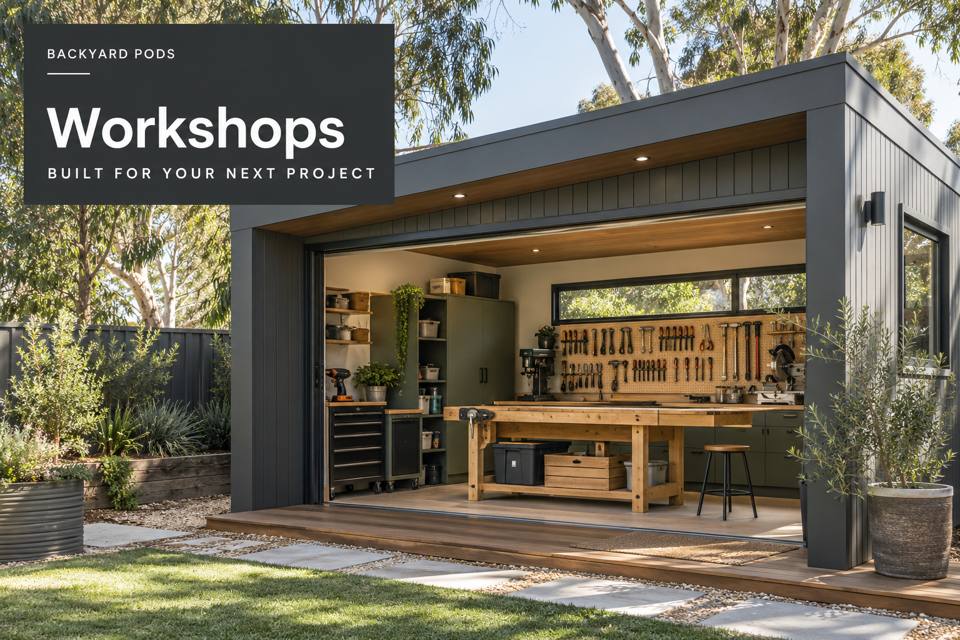
Bundaberg Workshops for a Small Maker's Packing and Collection Routine: explore practical layout choices, material and service coordination, and a clear project brief based on the intended use.
◈ Define the purpose before choosing the fitout
A maker's workshop should include the point at which completed work leaves the room. At a Bundaberg property, regional craft or coastal references may inform the product, while packing and collection require measured surfaces and clear movement. Describe the actual operations and equipment, obtaining appropriate professional input for the room's intended use and services before the fitout is ordered.
A clean packing surface apart from active fabrication
Completed pieces need a surface where they can be checked and packaged. Locate it separately from the busiest work position where practical. Its dimensions and supports should suit the products and intended loads, including the packaging footprint around the finished object.
Packaging organised by the actual object range
Measure the boxes, protective materials and labels used for the normal products. Group them according to the packing sequence. An organised limited collection can be more useful than a large cupboard filled with mixed packaging that must be emptied before each object is prepared.
The departure route tested with the packed item
The finished piece may become larger or less convenient to handle once packaged. Measure that footprint and review the route through the workshop entrance. Include relevant handling advice and delivery arrangements rather than assuming an object that fits on the bench can leave easily.
Handover records matched to the supplied work
Identify the information the customer genuinely needs, such as material care and agreed dimensions. Follow the business's own record procedures. Keep current handover paperwork near the packing position without mixing it with unrelated fabrication notes or earlier project versions.
▦ Compare the details that matter
| Design decision | Information to request | Intended result |
|---|---|---|
| A clean packing surface apart from active fabrication | A measured packing surface with suitable supports distinct from the principal fabrication position | Finished work being prepared for collection without covering the active making surface |
| Packaging organised by the actual object range | A packaging inventory arranged by product dimensions and the maker's actual preparation sequence | The appropriate packing materials being retrieved together for each completed object |
| The departure route tested with the packed item | A packed-product access review covering handling requirements and the workshop's departure route | Prepared work leaving the room through an assessed and practical collection sequence |
| Handover records matched to the supplied work | A project-specific handover information position linked to the maker's established record procedure | The completed work being accompanied by identifiable and relevant customer information |
When comparing workshops in Bundaberg, bring information about a clean packing surface apart from active fabrication to the consultation. For an address in Queensland, confirm the relevant site and use requirements with appropriate professionals. Review handover records matched to the supplied work within the same coordinated proposal.
Practical priorities for the quotation
- Request a measured packing surface with suitable supports distinct from the principal fabrication position; clarify the responsible contributor.
- Document a packaging inventory arranged by product dimensions and the maker's actual preparation sequence; clarify the responsible contributor.
- Retain a packed-product access review covering handling requirements and the workshop's departure route; clarify the responsible contributor.
- Include a project-specific handover information position linked to the maker's established record procedure; clarify the responsible contributor.
✓ Develop the proposal in five steps
- Review a clean packing surface apart from active fabrication with the provider. Ask how the proposal supports finished work being prepared for collection without covering the active making surface.
- Review packaging organised by the actual object range with the provider. Ask how the proposal supports the appropriate packing materials being retrieved together for each completed object.
- Review the departure route tested with the packed item with the provider. Ask how the proposal supports prepared work leaving the room through an assessed and practical collection sequence.
- Review handover records matched to the supplied work with the provider. Ask how the proposal supports the completed work being accompanied by identifiable and relevant customer information.
- Confirm the coordinated scope, with a project-specific handover information position linked to the maker's established record procedure, before manufacture or installation is committed.
Summary: a room with a documented purpose
Bundaberg Workshops for a Small Maker's Packing and Collection Routine benefits from decisions tied to actual users and property conditions. Start with finished work being prepared for collection without covering the active making surface. Coordinate this with the appropriate packing materials being retrieved together for each completed object. The supporting brief should also address prepared work leaving the room through an assessed and practical collection sequence. At the final review, confirm the provisions for the completed work being accompanied by identifiable and relevant customer information. Use the drawings, product information and itemised scope as the agreed project reference.
