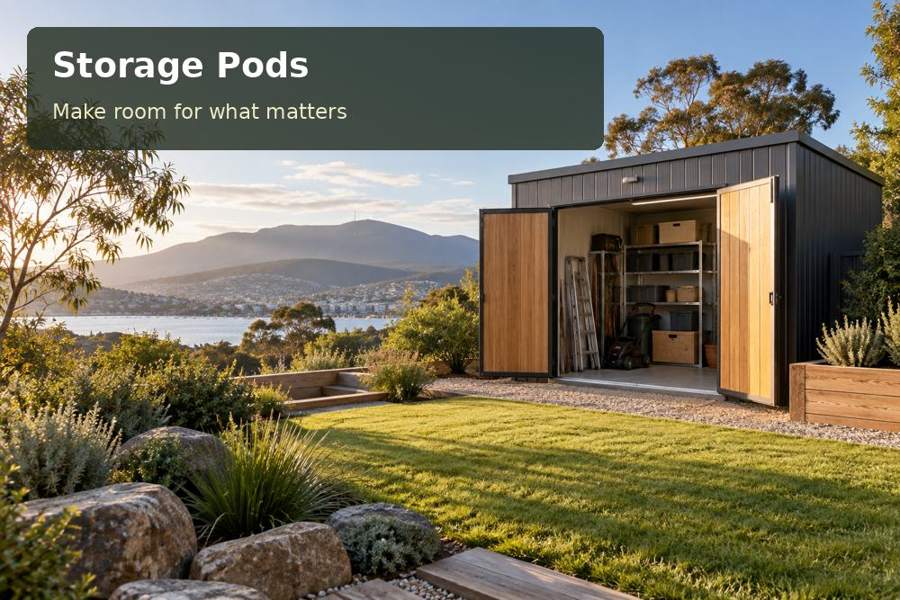
Organise camping equipment in a Taree storage pod with measured bays, a defined return routine and accessible space for checking gear before departure.
Camping equipment is easiest to manage when packing for a trip and putting things away are treated as related activities. A storage pod in Taree can bring tents, folded furniture and accessories into a clear system instead of spreading them through the garage. The room should help the household see what is ready to use, what needs attention and what has not yet been returned to storage. Organisation begins with the collection, not with buying matching containers.
Sort the equipment before measuring shelves
List what the household actually takes away. Separate frequently used items from occasional extras and identify anything awaiting repair or replacement. Measure folded furniture and packed equipment in the form in which it will be stored. Include handles, protruding parts and the movement needed to lift a bulky item out.
Taree's Manning River setting provides a local outdoor connection. At the home, investigate the actual garden approach and room conditions. A storage proposal should not assume equipment can be put away damp merely because the collection is intended for outdoor use.
Give returned gear an intermediate state
Equipment returning from a trip may require cleaning, drying or checking in accordance with its instructions. Define where those tasks occur before allocating permanent storage. A temporary return position can help keep unchecked gear distinct, provided it does not become an indefinite heap beside the entrance.
| Equipment group | Useful arrangement | Retrieval question |
|---|---|---|
| Folded furniture | Supported measured bay | Can one piece be removed without moving every other item? |
| Packed shelter equipment | Identified compartment | Is its ready-to-use condition clear? |
| Small accessories | Labelled containers | Does the label describe a complete useful set? |
| Items needing attention | Separate review position | Who checks and returns them to storage? |
Store each collection according to its care instructions. Different materials and products can require different conditions. Keep any fuels or other specialised products out of a general storage assumption and obtain appropriate advice for their actual requirements.
Make the aisle a working space
A clear aisle allows a household member to inspect, count and carry equipment. Measure it with the largest item being retrieved rather than considering only a person walking empty-handed. Avoid arranging heavy pieces where removal requires awkward overhead handling.
Discuss racks and shelving with a carpenter or suitable storage installer. Provide the expected loads and fixing requirements. Adjustable bays can accommodate a changing collection, but their use still needs a consistent inventory so equipment does not become lost behind unrelated possessions.
- Mark checked equipment separately from returned items.
- Keep repair notes associated with the relevant piece.
- Identify spare components by the equipment they belong to.
- Leave servicing and ventilation access free of boxes.
Match the building to storage use
For New South Wales storage-pod proposals, describe the contents and activities accurately. Confirm site suitability and the intended building arrangement with advisers. Supports and drainage need to follow the address, especially where the room meets a changing garden level or an existing path.
Plan lighting so labels and item condition can be checked without moving everything outdoors. Coordinate any electrical requirements with an electrician. Review ventilation and moisture management with the project team rather than relying on improvised devices after the equipment is installed.
Construction delivery needs its own access review. Record gates, turns and overhead obstacles, and agree on the unloading arrangement. The completed retrieval route should remain useful when carrying packed equipment towards the vehicle.
Build the storage system in five steps
- Inventory and sort the camping collection by use and condition.
- Measure each packed item and its removal movement.
- Define cleaning, drying and checking arrangements before permanent storage.
- Coordinate shelves, room conditions, site works and access.
- Pack a complete trip and test the return routine afterwards.
Explore storage pods with photographs and an equipment list. A Taree camping store can make departures simpler and returns more orderly when its layout supports the full cycle of ownership rather than only the moment everything is neatly put away.
