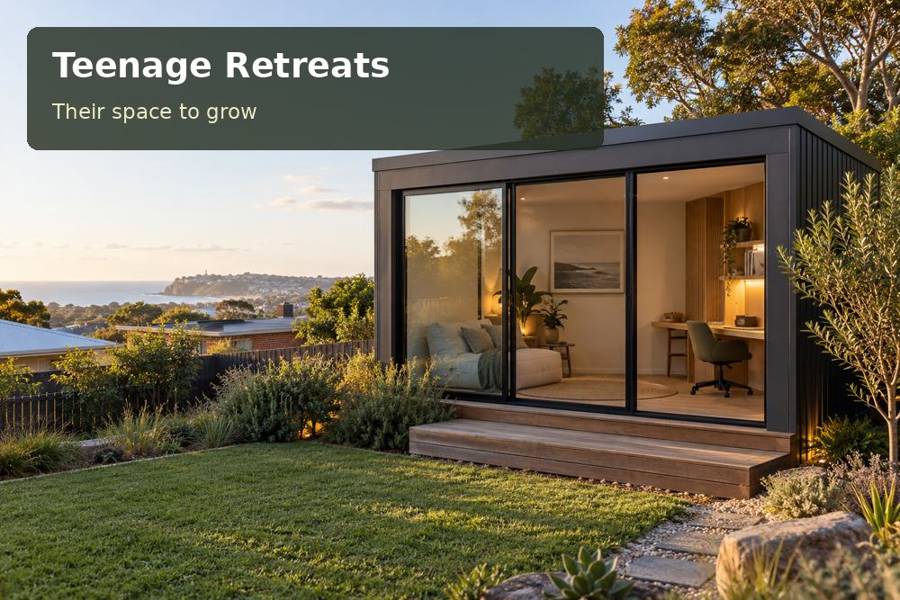
Give nature journals, photographs and school investigations an organised private garden room with practical storage and measured work surfaces.
A teenage retreat in Dubbo can provide a home for nature journals, landscape photographs and school investigations. The room can hold the materials used after an outing: notebooks, binoculars, a computer and specimens appropriate for ordinary indoor storage. Its purpose is to help a young observer organise information, with work surfaces and cupboards designed around that activity.
Follow the journey from outing to notebook
Begin at the entrance with a place for footwear and a bag. The desk then needs room for handwritten notes beside a device used to sort photographs. Ask the teenager to show the equipment rather than estimating storage from memory. Binoculars, camera bags and folders have different dimensions and handling needs, so a shallow drawer may suit some items while a larger cupboard serves others.
A display rail can hold maps and current observations without covering the desk. If the room includes hobby equipment, record its care requirements and any limits on storage. Living animals, chemicals or specialist apparatus should not be assumed suitable for a general teenage pod. Keep the brief focused on the activities the room can responsibly accommodate and obtain specific advice where it extends beyond ordinary study.
Connect the room to a genuine local landscape
Dubbo Regional Council documents a shared pathway and viewing platforms along the Macquarie River. That river setting offers a grounded reference for a young person interested in observing the outdoors. A garden retreat can frame existing planting or provide a place to review photographs after local outings without claiming that wildlife will visit the building.
Identify trees and habitat features around the proposed footprint. Avoid broad exterior lighting into vegetation, and ask for advice before works that affect roots or branches. A window beside the desk can provide daylight while preserving a storage wall. Inspect direct sun during the intended use hours and coordinate shade, insulation and any assessed cooling requirements rather than expecting the view alone to make a comfortable room.
| Observation material | Storage or surface idea | Information needed |
|---|---|---|
| Field notebooks and maps | Flat work area and accessible paper storage | Sheet sizes and folder thickness |
| Optical or camera equipment | Closed compartments with suitable care conditions | Product instructions and bag dimensions |
| Current school investigation | Changeable display panel | Viewing height and wall clearance |
Make installation fit the garden
Have soil conditions, levels and underground services assessed before settling supports. The project needs an appropriate foundation strategy and a lawful drainage destination, including how runoff moves around the entrance. If a terrace is proposed, dimension it for footwear handling and a clear route through the open doorway. Maintain access beneath a raised floor and around exterior surfaces for inspection.
Ask how the chosen building method will pass through the gate and where materials or a module can be unloaded. Protect established planting with an agreed working route. Consider New South Wales context alongside teenage retreats information while recording private daytime use. A room for overnight stays, independent residence or paid activity is a separate intention and should be assessed before production, not added casually once the study furniture arrives.
Inclusions with a clear purpose
- A map drawer or upright compartment chosen for the teenager’s actual paper collection.
- A removable bench protector for sorting appropriate materials brought home from outings.
- Directed entry lighting that supports the path while keeping unnecessary light away from vegetation.
Brief the room around one real outing
- Photograph the equipment and materials normally carried and brought home.
- Measure the desk arrangement needed to write notes and review images simultaneously.
- Mark the garden footprint and identify planting that should be protected.
- Obtain ground, drainage and approval advice, then coordinate windows and services.
- Request a proposal explaining storage, construction access, supports and maintenance responsibilities.
Give curiosity a well organised setting
A Dubbo field-journal retreat can be both distinctive and practical when the teenager’s interests guide its fittings. Bring notebooks, equipment dimensions and a few landscape photographs to a consultation. Ask for a concept that joins the observation desk to a real garden outlook, with the groundwork and installation scope made explicit.
