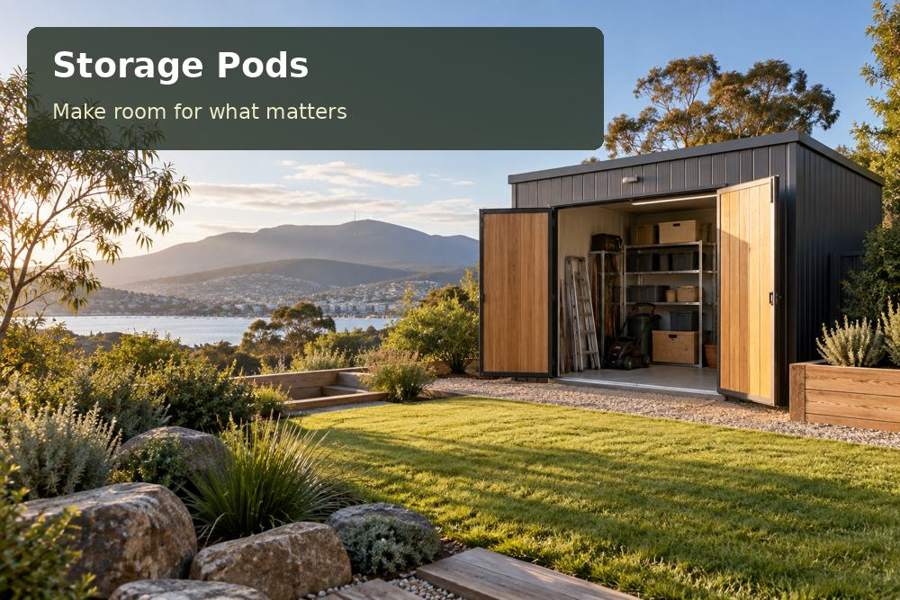
Good equipment storage lets an outing begin with preparation rather than a search through mixed cartons. Seek a leisure-storage proposal showing long-item bays and a usable receiving area.
Good equipment storage lets an outing begin with preparation rather than a search through mixed cartons. For Gosford, this approach gives coastal leisure organisation a clear practical focus. Consider storage pods with the objects, users and handling requirements visible from the first design discussion.
Read the property before selecting a pod
Gosford sits beside Brisbane Water, an estuary described by Central Coast Council as having high scenic value and areas of pristine vegetation. A pod should respond to its particular address, not borrow assumptions from the waterfront. Survey differences between the proposed pad and the access driveway, look for established trees and check where runoff already travels. On a constrained garden site, the distance between the vehicle and the door may matter as much as the internal area. Keep views, neighbour relationships and the maintenance route visible in the first layout. Setting reference: Brisbane Water.
Coastal leisure organisation
An orderly store for paddling accessories, folding chairs and beach equipment needs an intake routine as well as attractive shelving. Specify a place where cleaned items can be inspected before joining the dry collection, and choose finishes suited to the materials being stored. Long accessories can have a dedicated horizontal or vertical bay, subject to safe restraint and convenient reach. Make shelf depth fit actual boxes rather than buying a standard layout and hoping it works. A clear central aisle lets two people prepare for an outing without turning the entrance into a bottleneck.
Bring construction and use together
Design the room around length before considering decorative cupboards. A long paddle, rolled mat or awkward folding frame may establish the useful wall dimension even when its floor area is small. Ask for a full internal elevation, showing supports and the space needed to release each item. Restraints should be selected for their actual objects, with safe reach and reliable attachment assessed by the project team.
Consider the contrast between the receiving end and the packed end of the store. Easily cleaned surfaces near the entrance can assist organisation, but ordinary cladding and floor finishes should not be represented as suitable for every wet or salty object. Follow equipment care instructions and establish the building’s specified internal conditions.
A narrow side passage may favour one delivery approach over another. Give the supplier measured information before accepting a module size, and have any specialised placement operations professionally planned. After handover, use the empty space beside the entrance for checking equipment rather than permanently filling it with boxes. The ability to put something down safely is an important part of the room’s useful capacity.
Compare the specific priorities
| Project component | Practical consideration | Review document |
|---|---|---|
| Long accessories | Record the lengths of paddles and folded equipment | A measured inventory or task record |
| Dry packed gear | Separate returned objects from packed dry contents | A scaled movement and furniture drawing |
| Sorting at entry | Select safe restraints for awkward accessories | Written suitability advice where required |
Items for the project review
- Separate returned objects from packed dry contents.
- Verify the narrowest point on the approach.
- Leave a clear checking surface after unpacking.
Check the intended use, site conditions and relevant New South Wales requirements with qualified professionals and the responsible authorities during design development.
A practical route to design sign-off
- Document the inventory and record the lengths of paddles and folded equipment. Record the conclusion in the proposal.
- Use the room drawing to separate returned objects from packed dry contents. Name the party responsible for completion.
- Seek qualified advice to select safe restraints for awkward accessories. Retain this information after handover.
- Give the delivery provider enough information to verify the narrowest point on the approach. Use dimensions from the actual property.
- Finish the planning process by agreeing to leave a clear checking surface after unpacking. Keep the intended users involved.
Summary and proposal
Seek a leisure-storage proposal showing long-item bays and a usable receiving area. The design should explain how ordinary equipment will be handled, with documented limits for items requiring different storage conditions.
