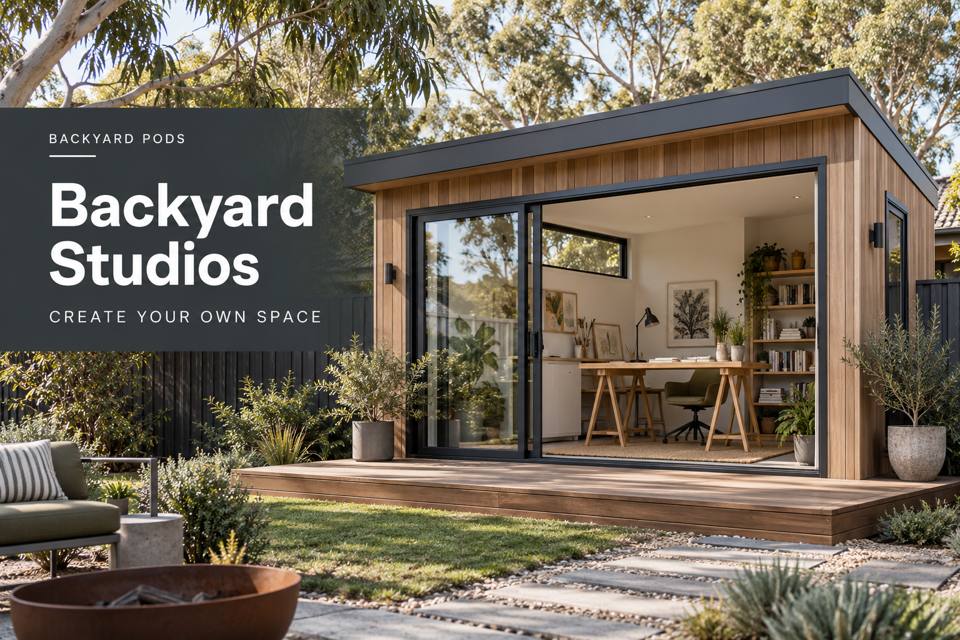
Create a purposeful ceramic handbuilding studio in Victor Harbor with separate clay preparation, clean display, drying and transport arrangements.
◈ Give the craft its own working sequence
Clay work needs somewhere to begin, somewhere to pause and somewhere to leave safely. A dedicated room becomes valuable when those stages have distinct positions. Explore backyard studios in Victor Harbor with a handbuilding brief that describes the clay, tools and largest pieces you expect to handle. The aim is a useful creative environment, with its layout developed around the craft rather than a generic desk-and-sofa arrangement.
Victor Harbor's coastal setting offers a visual starting point for textures and colours. Translating that inspiration into a studio does not require an enormous window. A controlled view, a practical bench and an organised display wall can contribute more to daily work than glazing that occupies every storage surface.
Separate preparation from clean presentation
Start by mapping the journey of a single piece: clay storage, preparation, handbuilding, drying, inspection and packing. This simple exercise reveals where surfaces need to remain available. A table used for every stage may leave fresh work competing with tools and packaging. Give drying pieces a labelled shelf or protected holding zone, with supports sized for their actual dimensions.
A clean review surface serves a different purpose. It lets you compare shapes, photograph completed work and prepare a collection without repeatedly clearing the active clay bench. If visitors will view pieces, position that surface where they can approach without crossing the work process.
Design around cleaning and material instructions
Describe the products used before selecting floors, wall finishes or cleaning facilities. Clay and associated materials have handling requirements that should inform the room arrangement. Follow supplier safety instructions, and obtain appropriate advice about dust control, cleaning methods and ventilation. Avoid treating an ordinary open window as evidence that a process has been adequately assessed.
This brief covers handbuilding; it does not assume that a kiln can simply be added later. Firing equipment needs its own professional review of electrical supply, installation conditions and any relevant permissions. Record whether firing will occur elsewhere so providers price the intended studio accurately.
▦ Compare the fit-out decisions
| Work stage | Useful provision | Detail to confirm |
|---|---|---|
| Clay preparation | A dedicated working surface | Dimensions, cleanability and product handling |
| Drying | Protected labelled shelves | Piece sizes and support requirements |
| Review | A clean display surface | Lighting and visitor access |
| Dispatch | Packing space near the exit | Packed dimensions and carrying route |
Put services and access in the same brief
A wash-up proposal is incomplete until the connection and disposal arrangements are understood. Ask qualified providers to assess the relevant plumbing and wastewater scope. Keep storage and packing away from that service zone, and make controls accessible after the benches are installed.
Delivery deserves similar attention. Bagged material, furniture and finished pieces all need a workable route. Measure the gate and doorway openings, note turning points and identify a protected receiving area. Those records help distinguish the building supply from separate groundwork, transport and fit-out services.
Quotation priorities
- Include the dimensions of the largest working and drying pieces.
- Identify which supplier provides benches, shelving and any cleaning facilities.
- Request care information for the proposed floor and wall products.
- Keep firing equipment outside the assumed scope unless separately assessed.
✓ Move from craft idea to project brief
- List your normal materials, tools and typical piece sizes.
- Draw the six-stage workflow, including drying and packing positions.
- Measure the delivery approach and record the available service information.
- Obtain appropriate advice on material handling and the cleaning arrangement.
- Compare itemised proposals, checking inclusions against the actual handbuilding routine.
Extend the design conversation
Use Ballarat Backyard Studios with a Heritage-Inspired Material Palette as a complementary studio example, then consult Gladstone Backyard Studios for Design Mood Boards and Material Decisions when considering another aspect of the working layout. Compare the wider backyard studios collection through the needs of your craft. Address-specific requirements in South Australia should be resolved before dependent construction or service work is ordered.
Summary
A convincing ceramic studio supports preparation, patient drying and careful presentation. Separate the dirty and clean stages, record the product requirements and keep the delivery route practical. The resulting brief gives providers a specific creative project to develop, with fewer assumptions hidden inside an attractive concept.
